
In this guide
- What are crypto futures?
- Liquidation: the number you must know before every trade
- Isolated vs cross margin
- Funding rate: the hidden cost of perpetual futures
- A simple futures trade plan
- Long and short crypto: when to do which
- What about crypto futures signals?
- Five rules that keep futures traders alive
- Frequently asked questions
Crypto futures trading lets you profit when the price goes up (long) or down (short), with leverage that multiplies both gains and losses. It is where most crypto volume happens and where most beginners lose money, usually for the same three reasons: too much leverage, no stop loss and no idea where liquidation sits. This guide fixes all three.
What are crypto futures?
Most crypto futures are perpetual futures (perps): contracts that track the price of a coin such as BTC or ETH and never expire. You do not own the coin. You own a position that gains or loses value as the price moves.
- Long: you profit if the price rises.
- Short: you profit if the price falls.
- Margin: the money you put up for the position.
- Leverage: how many times larger the position is than your margin.
With 100 USDT of margin and 10x leverage you control a 1,000 USDT position. A 5% move in your favour makes 50 USDT (50% of your margin). A 5% move against you loses the same 50 USDT.
Liquidation: the number you must know before every trade
If the market moves against you far enough to wipe out your margin, the exchange liquidates the position: it closes it automatically and you lose that margin. The higher the leverage, the closer the liquidation price.
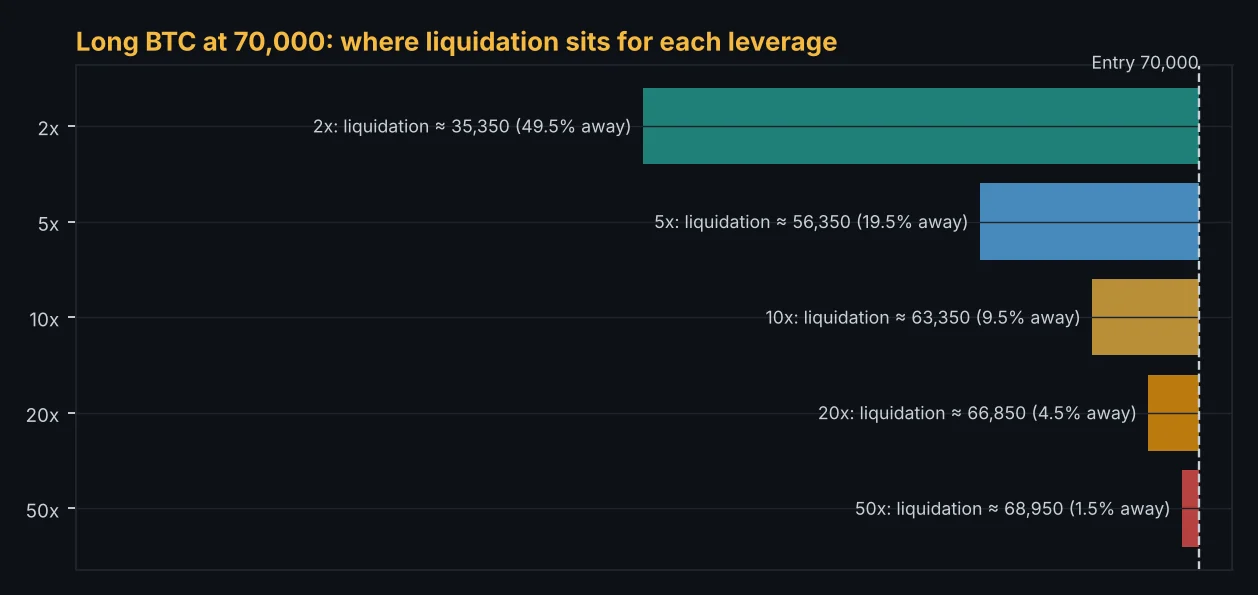
A normal Bitcoin day can easily move 2% to 4%. At 50x, that is enough to liquidate you even if your idea was right. That is why professionals in leverage trading crypto usually stay between 2x and 10x and use a stop loss well before the liquidation price.
Where a leveraged futures position is liquidated. Free, no sign-up.
Open the liquidation price calculatorIsolated vs cross margin
- Isolated margin: only the margin of that position can be lost. Best for beginners.
- Cross margin: your whole futures balance supports every position. A bad trade can drain the account.
Start with isolated margin and one position at a time.
Funding rate: the hidden cost of perpetual futures
Perpetual futures use a funding rate to stay close to the spot price. Every few hours (often every 8 hours), longs pay shorts when funding is positive, and shorts pay longs when it is negative.
- High positive funding means the market is crowded with longs. It also costs you money to hold a long.
- Very negative funding means shorts are crowded and a short squeeze becomes more likely.
Funding and open interest together are one of the best sentiment tools in crypto. When open interest jumps and funding is extreme, a sharp move against the crowd often follows.
Liquidation price, funding rates, open interest and the whale radar.
A simple futures trade plan
- Direction: use the higher timeframe trend. Long only above key support in an uptrend, short only below resistance in a downtrend.
- Entry: at a level, not in the middle of a move. A pullback to support or a breakout retest.
- Stop loss: where the idea is wrong, beyond the level, plus a buffer.
- Position size: risk a fixed 1% of your account. Work out the size from the distance to the stop.
- Leverage: only what you need to reach that size. Leverage should be the result of the plan, not the starting point.
- Targets: the next levels. Take partial profit and move the stop to break-even.
Lots and units from your risk and stop loss. Free, no sign-up.
Open the position size calculatorLong and short crypto: when to do which
Long and short crypto trades are equally valid. In a bull market, longs at support work best; in a bear market, shorts at resistance. In a range, both work at the edges. The mistake is fighting the trend: shorting every new high in a strong bull market or buying every dip in a crash.
What about crypto futures signals?
Many traders follow signals for entries and exits. A good signal always includes an entry, a stop loss and targets, and has a public track record. Even with the best crypto futures signals, you still decide the size and leverage, so the risk rules above still apply. The Alice Best Trades list gives setups with entry, stop loss and two targets for every market, and you can check them on the chart before you act.
Get entries and exits on Telegram and join the VIP discussion room. Message our support team to join.
Five rules that keep futures traders alive
- Never risk more than 1% to 2% of the account on one trade.
- Always place the stop loss when you open the trade.
- Keep leverage low, and check the liquidation price first.
- Avoid opening trades minutes before CPI, payrolls or a Fed decision.
- Keep a trading journal and review your trades every week.
Frequently asked questions
Is crypto futures trading good for beginners?
Only with low leverage, isolated margin, small size and a stop loss on every trade. Practise first with a demo account or very small positions.
What leverage should I use?
Most experienced traders use 2x to 10x. Choose the leverage that gives you the position size your 1% risk rule allows, not the maximum the exchange offers.
Why was I liquidated when the price came back?
Because the position was closed when the margin ran out. With high leverage, a normal wick can trigger liquidation before the price recovers. Lower leverage and a stop loss beyond the wick zone prevent this.
Which exchange is best for futures?
See our comparison of the best crypto exchanges for futures and copy trading, including fees and leverage.
This guide is for education only and is not financial advice. Trading involves a high risk of loss. Test any method on a demo account first and never risk money you cannot afford to lose.
Keep learning
 Crypto
Bitcoin Price Prediction: How to Read BTC Support, Resistance and Targets
How to make your own Bitcoin price prediction like a pro: BTC support and resistance, trend, targets, volume and the news that moves Bitcoin. A practical BTC analysis method for today and this week.
 Crypto
Best Time to Trade Crypto: Volume and Volatility by Hour and Day
Crypto trades 24/7, but not every hour is equal. When crypto volume peaks, why the US session matters, how weekends differ, and how to pick your trading hours.
 Crypto
Bitcoin Halving and Market Cycles Explained
What the Bitcoin halving is, the dates of every halving so far, how past cycles played out, and what traders should and should not expect from the four-year cycle.