
In this guide
Unlike stocks or forex, crypto never closes. You can buy Bitcoin at 3 a.m. on a Sunday. But "always open" does not mean "always active". Volume, volatility and liquidity rise and fall in a clear daily and weekly rhythm, and trading with that rhythm makes a real difference to spreads, slippage and the quality of moves.
Crypto follows the world's working hours
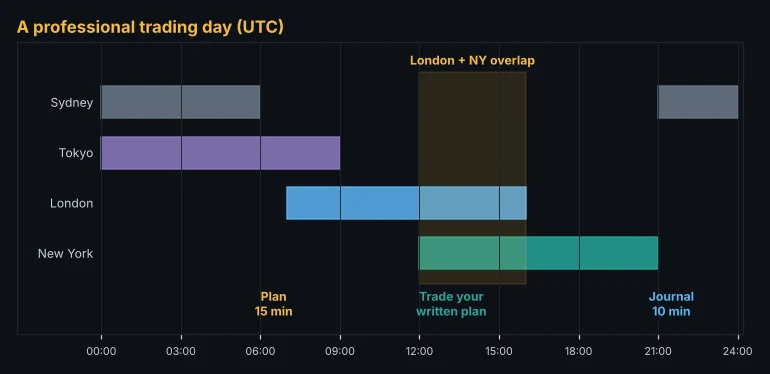
Even though crypto is global and never sleeps, most trading is still done by people and institutions in Asia, Europe and North America during their working day. That creates three broad phases in UTC time:
| UTC time | Who is active | Typical behaviour |
|---|---|---|
| 00:00 to 07:00 | Asia | Moderate volume, often ranges |
| 07:00 to 13:00 | Europe, Asia winding down | Volume builds, first trends of the day |
| 13:00 to 20:00 | Europe and US overlap, then US | Highest volume and biggest moves |
| 20:00 to 24:00 | US afternoon and evening | Volume fades |
The overlap of the European afternoon and the US morning is usually the busiest period, especially when US stock markets open and US economic data is released. Bitcoin increasingly moves with US stocks and the dollar, so US hours carry a lot of weight.
Weekends are different
Volume at weekends is usually clearly lower than on weekdays, because institutions, ETF flows and many professional traders are inactive. That has two effects:
- Quieter, choppier price action with fewer clean trends.
- Occasional sharp moves, because thin order books let a single large order push price further than it would on a weekday.
The Sunday evening and Monday open in UTC, when Asian and then European traders return, often brings the first proper move of the week, sometimes filling a gap with the CME Bitcoin futures, which do close at the weekend.
Funding times and the daily close
Two more timings matter for crypto traders:
- Funding times on perpetual futures, often every 8 hours at 00:00, 08:00 and 16:00 UTC on major exchanges. Price can wobble as traders adjust positions around them.
- The daily candle close at 00:00 UTC, which many traders use for daily levels and signals.
How to choose your hours
- Day traders and scalpers do best in the high-volume hours, roughly 12:00 to 20:00 UTC on weekdays, when spreads are tight and moves follow through.
- Swing traders can enter at any time but should be aware that weekend breakouts are less reliable.
- If you can only trade at night, focus on the most liquid coins and expect slower moves.
The exact pattern changes with the market. In strong bull markets, volume is high at almost all hours; in quiet markets, the difference between busy and dead hours is larger.
Measure it instead of guessing
The Crypto Peak Hours tool in the Alice app measures real exchange volume and price range for every hour of the day over the recent past and ranks each hour as high, medium or low activity, in UTC or your own time zone. It also compares weekend volume with weekdays. Because it is measured from current data, it adapts as the market changes.
The Alice scanner scores every crypto, forex, gold and index market from 0 to 100 on every timeframe, so you can spot these setups in seconds.
Open the free web appFrequently asked questions
What is the best day of the week to trade crypto?
Weekdays usually have more volume than weekends. Many traders find Monday to Thursday offer the cleanest trends, with Friday and the weekend more unpredictable.
Is it bad to trade crypto on weekends?
Not necessarily, but liquidity is lower and moves can be erratic. Use smaller positions and be careful with breakouts.
Does crypto follow forex market hours?
Not officially, but because the same people and institutions are active during European and US business hours, crypto volume tends to peak during the London and New York overlap too.
This guide is for education only and is not financial advice. Trading involves a high risk of loss. Test any method on a demo account first and never risk money you cannot afford to lose.
Keep learning
 Crypto
Bitcoin Halving and Market Cycles Explained
What the Bitcoin halving is, the dates of every halving so far, how past cycles played out, and what traders should and should not expect from the four-year cycle.
 Crypto
Crypto Funding Rates and Open Interest Explained
What perpetual futures funding rates and open interest tell you about crypto market positioning, how to read them together, and how traders use them to spot squeezes.
 Trading basics
Candlestick Patterns Every Trader Should Know (and When They Fail)
How to read candlestick charts and the patterns that matter most: engulfing, pin bar, doji, inside bar, morning and evening star. Plus how to filter out false signals.