
In this guide
Few events in crypto get as much attention as the Bitcoin halving. Every four years or so, the reward for mining new bitcoin is cut in half, and for much of Bitcoin's history the following year or two brought a major bull market. Here is how the halving works, what happened in past cycles, and how to think about it as a trader.
What the halving is
New bitcoins are created as a reward to miners who add blocks to the blockchain. Bitcoin's code cuts this block reward in half every 210,000 blocks. With a block roughly every 10 minutes, that is about every four years.
The rule is part of Bitcoin's fixed supply: there will never be more than 21 million bitcoins. Each halving slows the creation of new coins, and the last fractions of a bitcoin are expected to be mined around the year 2140.
Every halving so far
| Halving | Date | Block reward after |
|---|---|---|
| 1st | November 2012 | 25 BTC |
| 2nd | July 2016 | 12.5 BTC |
| 3rd | May 2020 | 6.25 BTC |
| 4th | April 2024 | 3.125 BTC |
| 5th | Expected around 2028 | 1.5625 BTC |
The four-year cycle
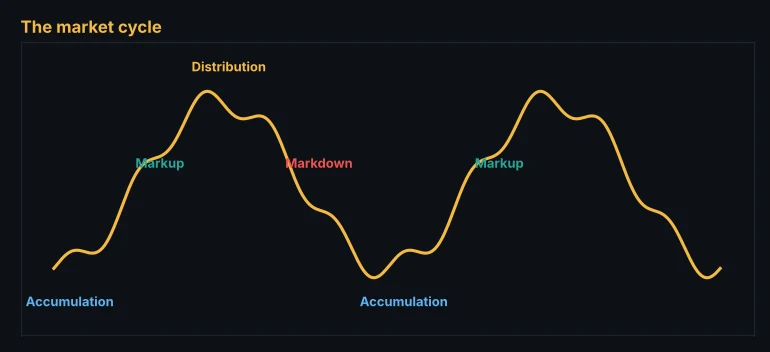
Past cycles have followed a broadly similar pattern:
- Before the halving, price recovers from the previous bear market.
- In the 12 to 18 months after, a strong bull market pushes Bitcoin to new all-time highs, as happened in late 2013, late 2017 and late 2021.
- Then a bear market follows, with drawdowns that have historically been very large.
- A bottom forms, and the cycle repeats.
The 2024 cycle broke the pattern a little: Bitcoin set a new all-time high in March 2024, before the halving, helped by the launch of spot Bitcoin ETFs in the US. It went on to trade above $100,000 for the first time in December 2024.
Why the halving might matter
The simple argument is supply and demand. Miners sell a part of their new coins to pay for electricity and equipment. When the reward halves, there are fewer new coins to sell every day. If demand stays the same or rises, price should face less selling pressure.
There is also a strong psychological effect: so many traders know about the cycle that it can become self-fulfilling for a while.
Why you should be careful with it
- Small sample. There have only been four halvings. Four data points are not a law of nature.
- The effect is shrinking. Each halving removes a smaller share of total supply than the last, because most bitcoin has already been mined.
- Bigger forces matter more now. ETF flows, interest rates, regulation and the global economy move Bitcoin much more than they did in 2012.
- Timing is vague. Even in past cycles, the peak came anywhere from about a year to a year and a half after the halving, with deep pullbacks along the way.
How traders use cycle thinking
The cycle is better used as context than as a signal:
- In the expected bull phase, focus on buying pullbacks in an uptrend rather than shorting tops.
- When price is far above long-term averages and leverage is extreme, reduce risk instead of adding.
- In bear phases, expect strong rallies that fail; take profits faster.
- Always use stops and position sizing. A cycle view does not protect you from a 30% drop inside a bull market, which has happened many times.
Where a leveraged futures position is liquidated. Free, no sign-up.
Open the liquidation price calculatorWatch the market, not the calendar
The best way to know which phase you are in is to watch the market itself: the trend on the weekly and daily charts, funding and open interest, and how the rest of crypto behaves. The BTC Deep Analysis in the Alice app combines Bitcoin's technicals with the dollar, US stocks, yields, funding, open interest, whale activity and the latest headlines into one daily verdict.
The Alice scanner scores every crypto, forex, gold and index market from 0 to 100 on every timeframe, so you can spot these setups in seconds.
Open the free web appFrequently asked questions
When is the next Bitcoin halving?
The fifth halving is expected around 2028, when block 1,050,000 is mined. The exact date depends on how fast blocks are found.
Does the price always go up after a halving?
In the past, the year after each halving brought new all-time highs, but four cycles are a small sample and there is no guarantee it will repeat.
How many bitcoins are left to mine?
Roughly 94% of the 21 million bitcoins had been mined by 2025. The remaining coins will be created more and more slowly over the next century.
This guide is for education only and is not financial advice. Trading involves a high risk of loss. Test any method on a demo account first and never risk money you cannot afford to lose.
Keep learning
 Crypto
Best Time to Trade Crypto: Volume and Volatility by Hour and Day
Crypto trades 24/7, but not every hour is equal. When crypto volume peaks, why the US session matters, how weekends differ, and how to pick your trading hours.
 Crypto
Crypto Funding Rates and Open Interest Explained
What perpetual futures funding rates and open interest tell you about crypto market positioning, how to read them together, and how traders use them to spot squeezes.
 Trading basics
Candlestick Patterns Every Trader Should Know (and When They Fail)
How to read candlestick charts and the patterns that matter most: engulfing, pin bar, doji, inside bar, morning and evening star. Plus how to filter out false signals.