
In this guide
Smart money concepts, usually shortened to SMC, have become one of the most talked-about ways to read charts. The vocabulary can sound intimidating, but most of the ideas are a fresh way of describing things price-action traders have always watched: trends, levels, imbalances and where stop losses are sitting.
This guide explains the core concepts in plain language.
The idea behind SMC
Large players such as banks and funds need a lot of liquidity to fill their orders. The theory is that price often moves toward areas where many orders are resting, especially clusters of stop losses, before making its real move. SMC tries to read the footprints those large orders leave on the chart.
You do not need to believe that every candle is a bank's plan. The concepts are useful on their own as a structured way of reading trend, levels and momentum.
Market structure: BOS and CHoCH
Everything in SMC starts with structure.
- An uptrend makes higher highs and higher lows.
- A downtrend makes lower highs and lower lows.
A break of structure (BOS) is when price breaks the previous swing in the direction of the trend: a new higher high in an uptrend. It confirms the trend is continuing.
A change of character (CHoCH) is the first break against the trend: in an uptrend, price breaking below the last higher low. It is an early warning that the trend may be turning.
Most SMC traders only look for trades in the direction of the higher-timeframe structure, and use CHoCH on a lower timeframe to time entries.
Order blocks
An order block is the last opposite-colored candle before a strong move that breaks structure. For a bullish order block, it is the last bearish candle before a powerful rally.
The idea is that large buy orders were placed in that candle, and some may still be unfilled. When price returns to the order block, those orders can push price up again.
A good order block:
- led to a clear break of structure
- produced a strong, fast move away, often leaving a fair value gap
- has not been revisited yet
Fair value gaps (FVG)
A fair value gap, also called an imbalance, is a three-candle pattern where the middle candle moves so fast that the wicks of the first and third candles do not overlap. That gap shows a one-sided move where little trading happened at those prices.
Price often comes back to fill part or all of an FVG before continuing. Combined with an order block in the same area, it marks a high-interest zone.
Liquidity and liquidity sweeps
Liquidity in SMC means resting orders, mostly stop losses:
- above obvious swing highs and equal highs, where short sellers place stops
- below swing lows and equal lows, where buyers place stops
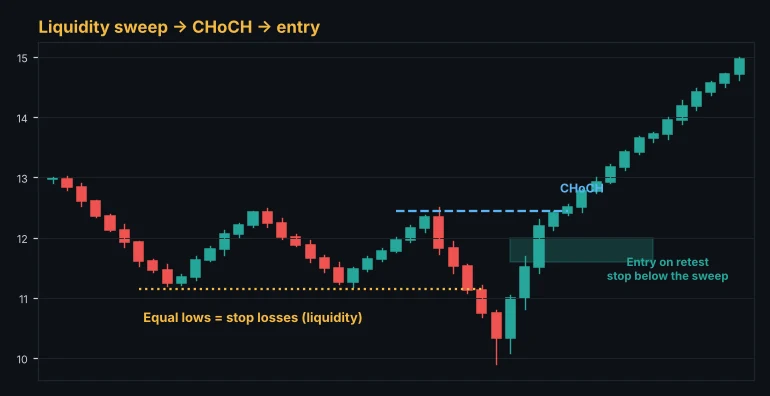
A liquidity sweep or stop hunt is when price spikes just beyond such a level, triggers those stops, and then reverses sharply. A sweep of equal lows followed by a bullish CHoCH is one of the classic SMC long setups.
Premium and discount
Take the current trading range, from swing low to swing high. The top half is premium, the bottom half discount, and the 50% line is equilibrium.
- In an uptrend, look to buy in discount.
- In a downtrend, look to sell in premium.
If this sounds like the Fibonacci 50% level, it is. SMC and Fibonacci traders are often looking at the same zones.
Retracement and extension levels from a swing. Free, no sign-up.
Open the fibonacci calculatorPutting it together: a simple SMC setup
- On the 4-hour chart, structure is bullish (higher highs, recent BOS).
- Price pulls back into the discount half of the range.
- It sweeps the liquidity below a recent swing low.
- On the 15-minute chart a bullish CHoCH forms.
- Entry at the order block or FVG that caused the CHoCH, stop below the sweep low.
- Target the 4-hour swing high, where the next liquidity sits.
The structure gives the direction, the sweep shows trapped sellers, and the order block gives a precise entry with a small stop.
Common mistakes
- Marking every candle as an order block. Only the ones that caused a break of structure matter.
- Trading against the higher-timeframe structure.
- Treating SMC as certain. Order blocks fail too; always use a stop loss and sensible risk.
SMC in Alice
When you open any market in the Alice app, the analysis includes a smart money section: current structure and the last BOS or CHoCH, the nearest bullish and bearish order blocks and fair value gaps, equal highs and lows, recent liquidity sweeps, and whether price is in premium or discount.
The Alice scanner scores every crypto, forex, gold and index market from 0 to 100 on every timeframe, so you can spot these setups in seconds.
Open the free web appFrequently asked questions
Is SMC better than classic technical analysis?
It is a different vocabulary for many of the same ideas. Some traders find its structure helpful; others prefer classic support and resistance. Both work only with good risk management.
What timeframe is best for SMC?
A common approach is to read structure on the 4-hour or daily chart and look for entries on the 5 to 15-minute chart.
What is the difference between an order block and a supply or demand zone?
They are very similar. An order block is a more precise version: the specific last candle before the move that broke structure.
This guide is for education only and is not financial advice. Trading involves a high risk of loss. Test any method on a demo account first and never risk money you cannot afford to lose.
Keep learning
 Strategy
Fibonacci Retracement Trading Guide: Levels, Golden Zone and Targets
How to draw Fibonacci retracements correctly, which levels matter (38.2%, 50%, 61.8%), how to use the golden zone for entries and extensions for targets, with examples.
 Strategy
How to Use a Market Scanner to Find Better Trades Faster
A practical guide to market scanners for crypto, forex and gold. What a scanner score means, how to filter by timeframe, how to go from a scan to a planned trade, and the pitfalls to avoid.
 Strategy
RSI Indicator Explained: Settings, Divergence and How to Trade It
The Relative Strength Index made simple. How RSI is calculated, what overbought and oversold really mean, the best settings, divergence, and the mistakes that cost traders money.