
In this guide
Moving averages are the most widely used indicator in trading, and for good reason. They smooth out noise, show the direction of the trend at a glance and act as dynamic support and resistance. Used well, they keep you on the right side of the market.
SMA vs EMA
- Simple moving average (SMA): the plain average of the last N closing prices. Every candle has equal weight.
- Exponential moving average (EMA): gives more weight to recent prices, so it reacts faster to new moves.
EMAs are popular with short-term traders because they turn sooner. SMAs are smoother and are often used for long-term levels such as the 200-day SMA.
The most watched settings
| Average | Typical use |
|---|---|
| 9 / 10 EMA | Very short-term momentum, scalping |
| 21 EMA | Short-term trend and pullback entries |
| 50 EMA / SMA | Medium-term trend, institutional reference |
| 200 EMA / SMA | Long-term trend: above is bullish, below is bearish |
Because so many traders watch the 50 and 200, price often reacts at them. That is a self-fulfilling effect worth respecting.
Reading the trend with moving averages
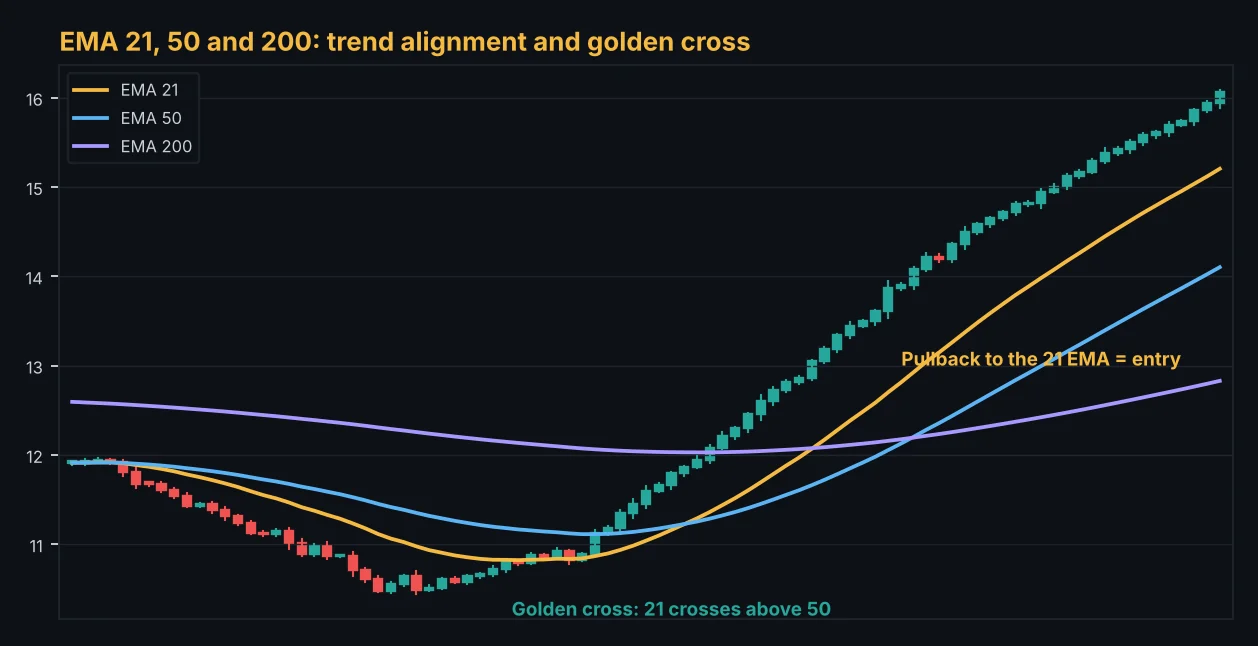
- Strong uptrend: price above the 21, the 21 above the 50, the 50 above the 200, all sloping up.
- Strong downtrend: the reverse.
- Range: averages flat and tangled, price crossing them constantly. In this condition, moving average signals fail often.
Strategy 1: Pullback to the EMA
In a clear uptrend, wait for price to pull back to the 21 or 50 EMA. Enter when a bullish candle forms at the average, with the stop below the recent swing low. This keeps you trading with the trend at a better price.
Strategy 2: The crossover
A golden cross happens when a faster average crosses above a slower one, such as the 50 crossing above the 200. A death cross is the opposite. Crossovers confirm trend changes but lag, so they work best on higher timeframes and with a filter such as the 200 EMA direction.
Strategy 3: The 200 EMA filter
Only take long trades when price is above the 200 EMA and only shorts below it. This one rule removes many counter-trend mistakes from any strategy.
Lots and units from your risk and stop loss. Free, no sign-up.
Open the position size calculatorLimitations
- Moving averages lag price. They confirm trends; they do not predict them.
- In ranging markets they give repeated false signals.
- No setting is magic. Consistency matters more than the exact number.
Moving averages in Alice
Every chart in Alice shows the 21, 50 and 200 EMA, and the trend part of the scanner score is built from moving average alignment and slope. The multi-timeframe matrix shows whether the higher timeframe agrees, which is the most common filter for EMA strategies.
The Alice scanner scores every crypto, forex, gold and index market from 0 to 100 on every timeframe, so you can spot these setups in seconds.
Open the free web appFrequently asked questions
What is the best moving average for day trading?
The 9 and 21 EMA for timing and the 200 EMA as a trend filter is a popular combination on the 5- to 15-minute charts.
Should I use EMA or SMA for the 200?
Both are widely watched. The difference is small; pick one and use it consistently.
Do moving averages work in crypto?
Yes. Crypto trends strongly, which suits moving averages, but volatility means you should give stops extra room.
This guide is for education only and is not financial advice. Trading involves a high risk of loss. Test any method on a demo account first and never risk money you cannot afford to lose.
Keep learning
 Strategy
Fibonacci Retracement Trading Guide: Levels, Golden Zone and Targets
How to draw Fibonacci retracements correctly, which levels matter (38.2%, 50%, 61.8%), how to use the golden zone for entries and extensions for targets, with examples.
 Strategy
How to Use a Market Scanner to Find Better Trades Faster
A practical guide to market scanners for crypto, forex and gold. What a scanner score means, how to filter by timeframe, how to go from a scan to a planned trade, and the pitfalls to avoid.
 Strategy
RSI Indicator Explained: Settings, Divergence and How to Trade It
The Relative Strength Index made simple. How RSI is calculated, what overbought and oversold really mean, the best settings, divergence, and the mistakes that cost traders money.