
In this guide
Have you ever placed a stop loss just below an obvious low, watched price hit it to the pip, and then reverse in the direction you expected? That was not bad luck. It was a liquidity sweep. Understanding where stops sit, and why the market goes after them, is one of the most useful ideas in smart money concepts.
What liquidity means
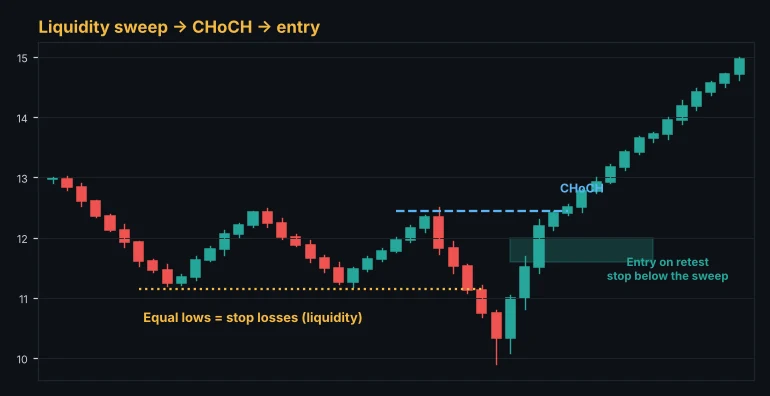
Big traders need someone to trade against. A fund that wants to buy a large position needs a large number of sellers. Where do they find them? At the stop losses of traders who are long. A buy stop loss is a sell order; a short trader's stop loss is a buy order.
Stops cluster in predictable places:
- Below equal lows and obvious support.
- Above equal highs and obvious resistance.
- Beyond trendlines that many traders are watching.
- Around round numbers like 1.1000 on EUR/USD or 60,000 on Bitcoin.
These clusters are called liquidity pools.
How a sweep works
- Price trades near an obvious level where many stops are waiting.
- It pushes through the level quickly, triggering the stops. That burst of orders gives large traders the liquidity they need.
- Once the stops are filled, there is no one left to push price further, and it snaps back.
The result is a long wick through the level or a short-lived break that quickly reverses.
Trading the reversal
Do not try to catch the exact wick. Wait for the market to show you the sweep is complete.
1. Mark the liquidity
Identify equal highs or lows and clear swing points on your trading timeframe.
2. Wait for the sweep
Price trades through the level and closes back inside the range.
3. Wait for a change of character (CHoCH)
On the same or a lower timeframe, price breaks the most recent swing in the opposite direction. For a sweep of lows, that means breaking the last lower high. This shows that buyers have taken over.
4. Enter on the retest
Look for price to return to the zone where the move began, such as an order block or a fair value gap. Enter there with the stop below the sweep low.
Lots and units from your risk and stop loss. Free, no sign-up.
Open the position size calculatorProtect yourself from stop hunts
- Do not put your stop exactly at an obvious level. Give it a buffer based on ATR.
- Use wider stops with smaller position size instead of tight stops with big size.
- Expect sweeps around the London and New York opens and before major news.
- If a level looks "too obvious", assume the market may test beyond it.
When sweeps fail
Not every break of a low is a sweep. Sometimes support simply breaks and price trends lower. The difference is the reaction: a sweep closes back inside quickly and is followed by a change of character. A true breakdown keeps closing outside the level.
Smart money concepts in Alice
Alice marks equal highs and lows as liquidity, shows breaks of structure and changes of character, and highlights order blocks and fair value gaps on the chart for Premium and Elite members. The Elite whale radar also shows when large orders hit the market.
The Alice scanner scores every crypto, forex, gold and index market from 0 to 100 on every timeframe, so you can spot these setups in seconds.
Open the free web appFrequently asked questions
Are stop hunts done on purpose?
Nobody needs to "hunt" individual traders. Large players simply need liquidity, and the biggest pools sit at obvious levels. The effect looks like a hunt.
What timeframe works best for sweeps?
Sweeps of daily and 4-hour highs and lows are the most significant. Many traders then use the 15-minute or 5-minute chart to find the change of character and entry.
Is this the same as a false breakout?
A liquidity sweep is a type of false breakout with a specific cause: triggering the stops beyond a level before reversing.
This guide is for education only and is not financial advice. Trading involves a high risk of loss. Test any method on a demo account first and never risk money you cannot afford to lose.
Keep learning
 Strategy
Fibonacci Retracement Trading Guide: Levels, Golden Zone and Targets
How to draw Fibonacci retracements correctly, which levels matter (38.2%, 50%, 61.8%), how to use the golden zone for entries and extensions for targets, with examples.
 Strategy
How to Use a Market Scanner to Find Better Trades Faster
A practical guide to market scanners for crypto, forex and gold. What a scanner score means, how to filter by timeframe, how to go from a scan to a planned trade, and the pitfalls to avoid.
 Strategy
RSI Indicator Explained: Settings, Divergence and How to Trade It
The Relative Strength Index made simple. How RSI is calculated, what overbought and oversold really mean, the best settings, divergence, and the mistakes that cost traders money.