
In this guide
The foreign exchange market is the largest financial market in the world, with trillions of dollars traded every day. It is open 24 hours from Monday to Friday and you can start with a small account. That accessibility is also its danger: it is easy to start and easy to lose money without a plan. This guide gives you the foundations.
What you are actually trading
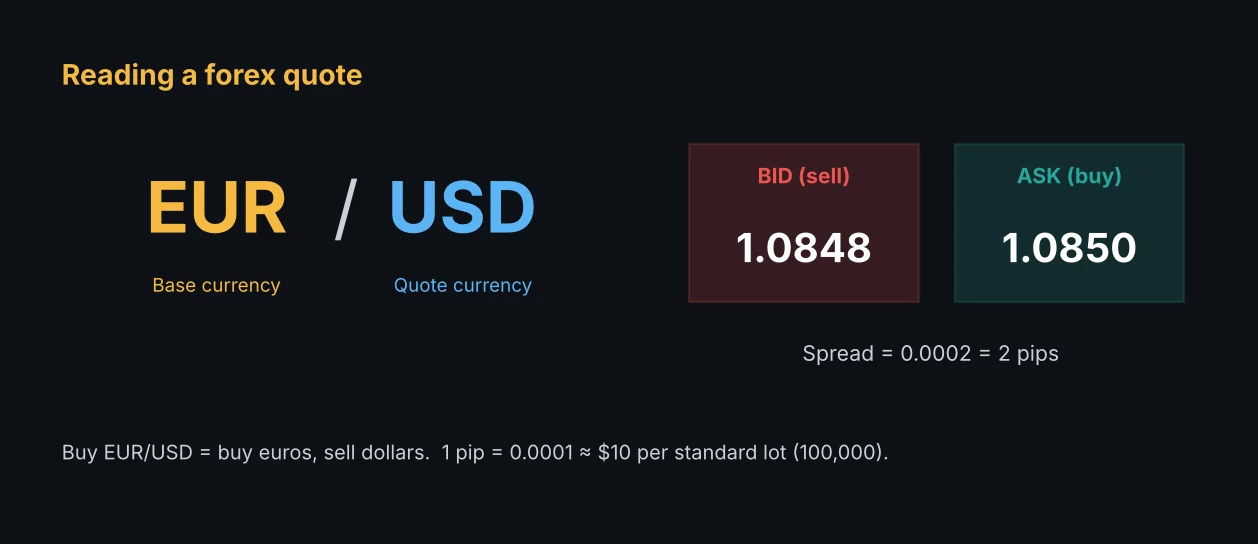
In forex you always trade one currency against another. In EUR/USD:
- EUR is the base currency.
- USD is the quote currency.
- A price of 1.0850 means one euro costs 1.0850 US dollars.
If you buy EUR/USD, you profit if the euro strengthens against the dollar. If you sell, you profit if it weakens.
Majors, crosses and exotics
- Majors: pairs with the US dollar such as EUR/USD, GBP/USD, USD/JPY. Tightest spreads, most liquidity.
- Crosses: pairs without the dollar, such as EUR/GBP or GBP/JPY.
- Exotics: a major currency against an emerging one, such as USD/TRY. Wide spreads and big swings.
Beginners usually do best with two or three major pairs and gold.
Bid, ask and spread
The bid is the price you sell at, the ask the price you buy at. The difference is the spread, a cost you pay on every trade. The more liquid the pair and the busier the session, the tighter the spread.
Pips and lots
- A pip is the standard unit of price movement: 0.0001 for most pairs, 0.01 for yen pairs.
- A standard lot is 100,000 units of the base currency, a mini lot 10,000 and a micro lot 1,000.
- On EUR/USD, one pip is worth about $10 on a standard lot, $1 on a mini lot and $0.10 on a micro lot.
What one pip is worth on any pair and lot size. Free, no sign-up.
Open the pip value calculatorLeverage and margin
Brokers let you control a large position with a small deposit called margin. With 1:100 leverage, $1,000 of margin controls $100,000. Leverage magnifies gains and losses equally. Your real risk should be decided by your stop loss and position size, not by the leverage your broker offers.
When to trade
Forex follows the sun through four sessions: Sydney, Tokyo, London and New York. The busiest time is the London–New York overlap, roughly 12:00 to 16:00 UTC.
Live sessions and overlaps in your time zone. Free, no sign-up.
Open the forex market hoursWhat moves currencies
- Interest rates and central bank decisions.
- Inflation data such as CPI.
- Employment data such as US non-farm payrolls.
- Growth data such as GDP and PMI.
- Risk sentiment: in fearful markets, money flows into the US dollar, Japanese yen and Swiss franc.
Your first trade plan
- Pick one pair and one timeframe, such as EUR/USD on the 1-hour chart.
- Identify the trend on the 4-hour or daily chart.
- Mark support and resistance.
- Wait for price to reach a level in the direction of the trend.
- Enter with a stop loss beyond the level and a target at least twice the risk.
- Size the position so the loss is no more than 1% of your account.
- Record the trade in a journal.
Lots and units from your risk and stop loss. Free, no sign-up.
Open the position size calculatorStart on a demo account
Practise on a demo account until you can follow your plan for at least a month of trades. Then move to a small live account. The goal of the first year is to survive and learn, not to get rich.
Learn faster with Alice
Alice scores every forex pair from 0 to 100 on every timeframe, shows currency strength so you can pair a strong currency with a weak one, and shows the forex sessions in your own time zone. The trading academy takes you from your first trade to advanced strategies.
The Alice scanner scores every crypto, forex, gold and index market from 0 to 100 on every timeframe, so you can spot these setups in seconds.
Open the free web appFrequently asked questions
How much money do I need to start forex trading?
You can open an account with a small amount, but a few hundred dollars and micro lots let you risk 1% per trade with sensible stops.
Is forex trading gambling?
Without a plan and risk management, it behaves like gambling. With a tested strategy, fixed risk and a journal, it becomes a skill-based activity, though still risky.
Which pair is best for beginners?
EUR/USD is a common choice: tight spreads, deep liquidity and plenty of educational material.
This guide is for education only and is not financial advice. Trading involves a high risk of loss. Test any method on a demo account first and never risk money you cannot afford to lose.
Keep learning
 Forex
ForexCurrency Strength Meter: How to Use It to Pick the Best Forex Pairs
Learn how a currency strength meter works and how to use it to pair the strongest currency against the weakest, confirm trends and avoid choppy pairs.
 Forex
ForexHow to Use the Economic Calendar: NFP, CPI and FOMC Explained
A trader's guide to the economic calendar. What NFP, CPI, FOMC and other high-impact events are, when they happen, how they move forex, gold and crypto, and how to trade around them.
 Forex
ForexForex Market Hours: The Best Time to Trade Forex in 2026
When is the forex market open? A clear guide to the Sydney, Tokyo, London and New York sessions, the overlaps that move the most, and the hours to avoid.