
In this guide
Most traders do not fail because their strategy is bad. They fail because they do not follow it. They move stops, double down after a loss, chase a move they missed, or risk too much after a winning streak. Trading psychology is the skill of doing the right thing even when your emotions are shouting at you to do the opposite.
The four emotions that cost the most
Fear
Fear makes you close winners too early, skip valid setups after a loss, and hesitate at entries. The cure is a plan you trust and a position size small enough that a loss does not hurt.
Greed
Greed makes you take profits too late, add to positions without a plan and risk too much. It peaks after a winning streak, which is exactly when discipline matters most.
FOMO
The fear of missing out makes you chase a candle that has already moved. Chasing usually means entering at a poor price with a wide stop. Remember: there is always another trade.
Revenge
After a loss, the urge to "win it back" leads to bigger size, worse setups and more losses. Revenge trading turns a small losing day into a disaster.
Risk per trade decides whether you survive
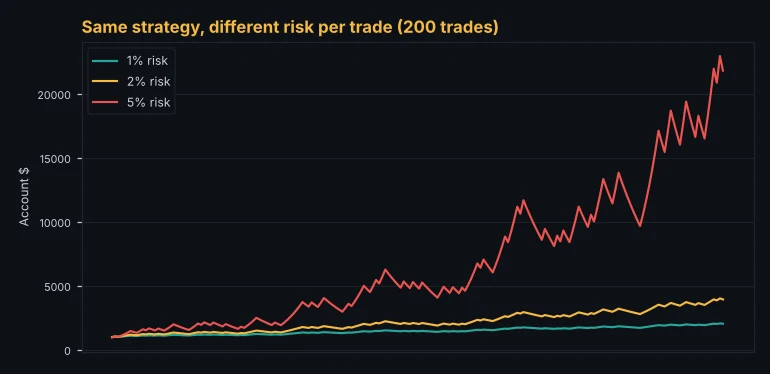
The chart above shows the same strategy traded with 1%, 2% and 5% risk per trade. With higher risk, the account grows faster in good streaks, but the drawdowns are huge, and a normal losing streak can destroy it. With 1% risk, ten losses in a row cost about 10%. With 5% risk, the same streak costs about 40%, and you need a 67% gain just to get back to where you started.
Lots and units from your risk and stop loss. Free, no sign-up.
Open the position size calculatorTen rules that build discipline
- Write your plan before the session. Bias, levels, setups and maximum loss for the day.
- Risk a fixed percentage of your account per trade, usually 0.5% to 1%.
- Set a daily loss limit. Stop trading after two or three losses, or after losing 2% to 3% in a day.
- Never move the stop loss away from price. You can move it closer to lock in profit, never further.
- Only trade your setups. If it is not in your plan, it is not a trade.
- Use alerts instead of staring at charts. Watching every tick creates impulsive trades.
- Take a break after a big win or a big loss. Both distort your judgement.
- Keep a journal, including how you felt before and after each trade.
- Review weekly. Look for patterns: which setups, sessions and emotions lead to losses?
- Think in a series of trades. One trade means nothing. The next 100 trades are what count.
Why a journal is your best psychology tool
When you log each trade with the setup, the result in R and your emotion, the patterns become obvious: maybe your revenge trades lose 80% of the time, or your Friday afternoon trades are all losers. Data turns vague feelings into clear rules.
Consistency compounds
Small, consistent gains grow an account far more reliably than occasional big wins. A steady 2% to 3% a month compounds into a meaningful result over a few years, without the risk of ruin.
Grow an account with a fixed % per trade or month. Free, no sign-up.
Open the compounding calculatorBuild your routine with Alice
Alice's trading journal records every trade with its strategy, session and emotion, and shows your win rate, average R, profit factor and best and worst pairs. Premium members also get an AI review of their habits. Alerts mean you can stop watching charts and let the server tell you when your level is hit.
The Alice scanner scores every crypto, forex, gold and index market from 0 to 100 on every timeframe, so you can spot these setups in seconds.
Open the free web appFrequently asked questions
How do I stop revenge trading?
Set a hard daily loss limit and walk away when you hit it. Make it a rule, not a decision you take in the moment.
Is it normal to feel nervous when trading?
Yes. If you feel very nervous, your position size is probably too large. Reduce it until a loss feels like a normal business cost.
How long does it take to become a disciplined trader?
It is a habit, so it builds with repetition. Following a written plan and reviewing your journal every week speeds it up a lot.
This guide is for education only and is not financial advice. Trading involves a high risk of loss. Test any method on a demo account first and never risk money you cannot afford to lose.
Keep learning
 Trading basics
Candlestick Patterns Every Trader Should Know (and When They Fail)
How to read candlestick charts and the patterns that matter most: engulfing, pin bar, doji, inside bar, morning and evening star. Plus how to filter out false signals.
 Trading basics
Crypto vs Forex Trading: Which Market Is Better for You?
An honest comparison of crypto and forex trading. Trading hours, volatility, leverage, costs, regulation and what each market rewards, so you can choose the right one for your style.
 Trading basics
How to Calculate Position Size in Forex and Crypto (With Examples)
Learn the position sizing formula that professional traders use. Step-by-step examples for forex, gold and Bitcoin, plus the mistakes that blow up accounts.