
In this guide
A stop loss is not a sign of weakness. It is the line that says "my idea was wrong", and it is what keeps one bad trade from becoming a disaster. But a stop placed in the wrong spot gets hit by normal noise just before the market goes your way. Here is how to place stops that make sense.
The golden rule: the stop decides the size
Never choose your position size first and then squeeze the stop to fit. Decide where your trade idea is proven wrong, place the stop there, and then calculate the position size so that hitting the stop costs a fixed percentage of your account.
Lots and units from your risk and stop loss. Free, no sign-up.
Open the position size calculatorMethod 1: Market structure
In an uptrend, a long trade is wrong if price makes a lower low. Place the stop below the most recent higher low. In a downtrend, place it above the most recent lower high. This is the most logical stop for trend trades.
Method 2: Beyond support or resistance
If you buy at support, the trade is wrong if support breaks. Place the stop below the whole support zone, not inside it. Zones have thickness; a stop in the middle will be hit by normal wicks.
Method 3: ATR-based stops
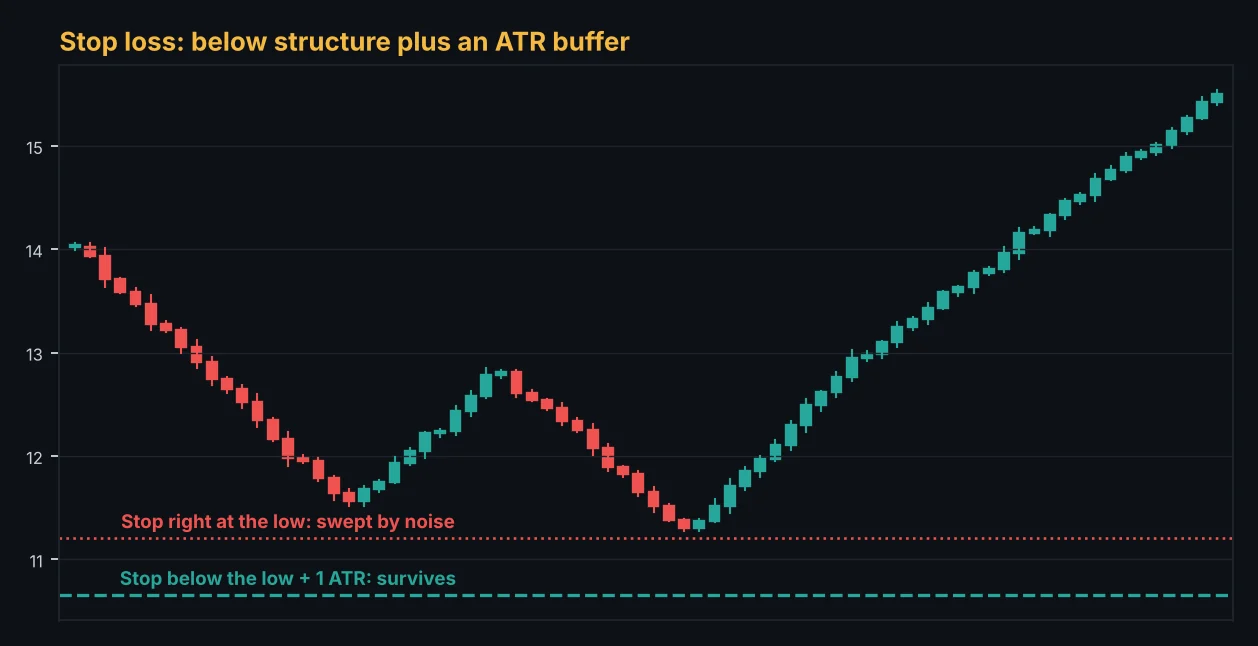
The Average True Range (ATR) measures how much a market typically moves per candle. A common approach is to place the stop 1 to 1.5 ATR beyond your structural level. This adapts the stop to volatility: wider in fast markets, tighter in quiet ones.
Method 4: Pattern stops
Chart patterns come with built-in stops:
- Head and shoulders: above the right shoulder.
- Flag: beyond the opposite side of the flag.
- Double bottom: below the two lows.
- Break and retest: on the other side of the retested zone.
Method 5: Time stops
If a trade has not moved in your favour after a set time, such as one session or a few days for a swing trade, close it. Capital stuck in a dead trade could be used for a better one.
Avoid the obvious spots
Stops cluster just below equal lows and round numbers. Large traders know this, and price often sweeps those levels before reversing. Add a buffer beyond the obvious level, and accept the slightly wider stop with a smaller position.
Trailing your stop
Once the trade moves in your favour:
- Move the stop to break-even after a planned point, such as 1R or the first target.
- Trail it below each new higher low (for longs) to lock in profit while letting the trend run.
- Do not trail so tightly that normal pullbacks stop you out.
Leverage and liquidation
On leveraged crypto futures, your stop must be well before the liquidation price. If it is not, lower the leverage. A stop that sits beyond liquidation is not a stop.
Where a leveraged futures position is liquidated. Free, no sign-up.
Open the liquidation price calculatorStops in Alice
Alice's Best Trades include a stop loss for every setup, and the support and resistance zones on each chart show where structure lies. The risk calculator pro turns your stop into a position size and warns when your stop is beyond the liquidation price.
The Alice scanner scores every crypto, forex, gold and index market from 0 to 100 on every timeframe, so you can spot these setups in seconds.
Open the free web appFrequently asked questions
Should I use a mental stop instead of a real one?
A real stop order is safer. Mental stops are easy to ignore when emotions run high, and they do not protect you if your connection fails.
How far should my stop be?
As far as the market structure requires, plus a buffer for volatility. Then adjust your position size, not the stop.
Is it okay to move my stop?
Moving it closer to lock in profit is fine. Moving it further away to avoid a loss breaks your plan and your risk control.
This guide is for education only and is not financial advice. Trading involves a high risk of loss. Test any method on a demo account first and never risk money you cannot afford to lose.
Keep learning
 Trading basics
Candlestick Patterns Every Trader Should Know (and When They Fail)
How to read candlestick charts and the patterns that matter most: engulfing, pin bar, doji, inside bar, morning and evening star. Plus how to filter out false signals.
 Trading basics
Crypto vs Forex Trading: Which Market Is Better for You?
An honest comparison of crypto and forex trading. Trading hours, volatility, leverage, costs, regulation and what each market rewards, so you can choose the right one for your style.
 Trading basics
How to Calculate Position Size in Forex and Crypto (With Examples)
Learn the position sizing formula that professional traders use. Step-by-step examples for forex, gold and Bitcoin, plus the mistakes that blow up accounts.