
In this guide
There is no single best way to trade. The right style depends on how much time you have, how you handle stress and which markets you trade. Choosing a style that fits your life is one of the most important decisions you will make, because a strategy you cannot follow consistently will not work for you.
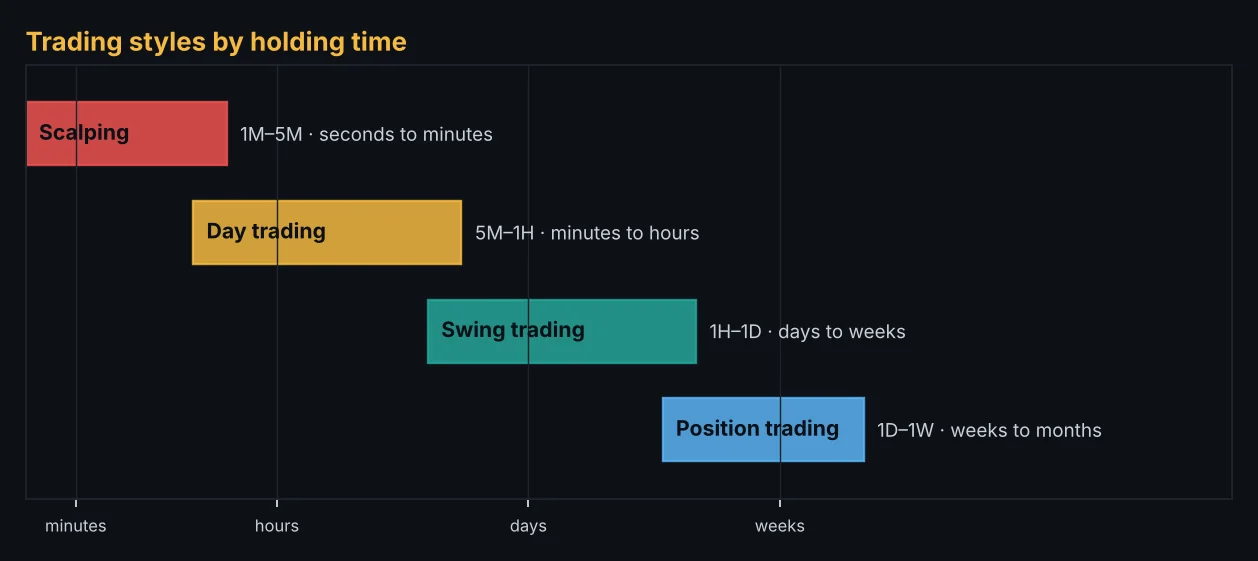
The four main styles
| Style | Chart timeframes | Holding time | Trades per week | Screen time |
|---|---|---|---|---|
| Scalping | 1M to 5M | Seconds to minutes | 20 to 100+ | High, focused |
| Day trading | 5M to 1H | Minutes to hours | 5 to 20 | 2 to 4 hours a day |
| Swing trading | 1H to 1D | Days to weeks | 1 to 5 | 30 to 60 minutes a day |
| Position trading | 1D to 1W | Weeks to months | A few a month | A few hours a week |
Scalping
Scalpers aim for small moves many times a day. They need tight spreads, fast execution and intense focus.
- Pros: many opportunities, no overnight risk, quick feedback.
- Cons: costs add up fast, very stressful, mistakes are frequent.
- Best for: experienced traders with low-cost accounts who can focus for long periods.
Day trading
Day traders open and close positions within the day, usually during the most active session.
- Pros: no overnight risk, clear daily routine, enough setups.
- Cons: needs several hours of free time during market hours.
- Best for: traders who can commit to a fixed session, such as London or New York.
Live sessions and overlaps in your time zone. Free, no sign-up.
Open the forex market hoursSwing trading
Swing traders capture moves that last several days, using the 4-hour and daily charts.
- Pros: fits around a full-time job, fewer and higher-quality trades, lower costs relative to profit.
- Cons: overnight and weekend risk, needs patience.
- Best for: most beginners and anyone with limited time.
Position trading
Position traders hold for weeks or months, following major trends and fundamentals.
- Pros: very little screen time, the biggest moves per trade.
- Cons: wide stops require small positions; long drawdowns test patience.
How to choose
Ask yourself:
- How much time do I really have? Be honest. If it is one hour in the evening, swing trading is the natural fit.
- How do I handle stress? Fast decisions under pressure suit scalpers. Slower, planned decisions suit swing traders.
- What are my costs? High spreads or fees make scalping almost impossible to profit from.
- What is my personality? Patient people often prefer swing trading; action-oriented people lean toward day trading.
The style changes the numbers
Shorter timeframes mean smaller stops and targets, so spreads take a bigger share of every trade. A 1-pip spread is 20% of a 5-pip scalp but only 2% of a 50-pip swing. That is why many beginners do better on higher timeframes.
Risk, reward, ratio and break-even win rate. Free, no sign-up.
Open the risk reward calculatorEvery style in Alice
Alice's Best Trades marks each setup as scalping (15M and 1H) or intraday (1H and 4H), and the scanner covers every timeframe from 1 minute to 1 month. Set alerts at your levels so a swing trading plan can run while you work.
The Alice scanner scores every crypto, forex, gold and index market from 0 to 100 on every timeframe, so you can spot these setups in seconds.
Open the free web appFrequently asked questions
Which trading style is best for beginners?
Swing trading usually is: it gives time to think, has lower costs per trade and fits around work.
Can I combine styles?
Yes, but keep separate rules and statistics for each style so you know what actually works.
Is scalping profitable?
It can be for a small number of disciplined traders with very low costs. For most beginners, costs and stress make it the hardest style.
This guide is for education only and is not financial advice. Trading involves a high risk of loss. Test any method on a demo account first and never risk money you cannot afford to lose.
Keep learning
 Trading basics
Candlestick Patterns Every Trader Should Know (and When They Fail)
How to read candlestick charts and the patterns that matter most: engulfing, pin bar, doji, inside bar, morning and evening star. Plus how to filter out false signals.
 Trading basics
Crypto vs Forex Trading: Which Market Is Better for You?
An honest comparison of crypto and forex trading. Trading hours, volatility, leverage, costs, regulation and what each market rewards, so you can choose the right one for your style.
 Trading basics
How to Calculate Position Size in Forex and Crypto (With Examples)
Learn the position sizing formula that professional traders use. Step-by-step examples for forex, gold and Bitcoin, plus the mistakes that blow up accounts.