
In this guide
Almost every trader who blows up an account had at least one idea that worked. What they lacked was a plan for when the idea did not work. Risk management is that plan. It is not exciting, but it is the part of trading you fully control, and it is the reason good traders survive long enough for their edge to pay off.
The 1% rule
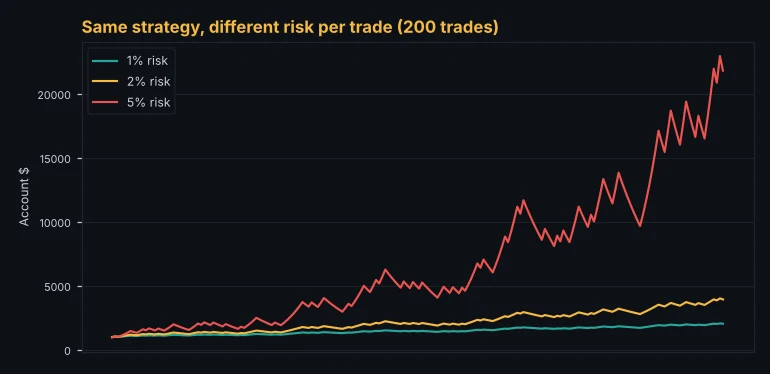
The 1% rule says: never risk more than 1% of your account on a single trade. "Risk" means the amount you lose if your stop loss is hit, not the size of the position.
With a $5,000 account, 1% is $50. Whether you trade EUR/USD with a 20-pip stop or Bitcoin with a $1,500 stop, you size the position so that being wrong costs about $50.
The rule works because of what it prevents. With 1% risk:
- ten losses in a row leave you with about 90% of your account
- you need about an 11% gain to recover from a 10% drawdown
- no single trade can do serious damage
Some traders use 0.5%, others up to 2%. The exact number matters less than using the same rule every time.
Lots and units from your risk and stop loss. Free, no sign-up.
Open the position size calculatorWhy recovering from losses is so hard
Losses and gains are not symmetrical:
| Drawdown | Gain needed to recover |
|---|---|
| 10% | 11.1% |
| 20% | 25% |
| 30% | 42.9% |
| 50% | 100% |
| 75% | 300% |
Lose half your account and you have to double what is left just to get back to zero. That is why protecting capital comes before making money.
Risk to reward and win rate work together
Your results depend on two numbers: how often you win, and how much you make when you win compared with what you lose.
Expectancy per trade = (Win rate × Average win) − (Loss rate × Average loss)
A trader who wins 40% of the time but makes 2.5 times what they lose has a positive expectancy: 0.4 × 2.5 − 0.6 × 1 = 0.4R per trade. A trader who wins 70% of the time but loses three times more on losers than they make on winners is slowly going broke: 0.7 × 1 − 0.3 × 3 = −0.2R.
Risk, reward, ratio and break-even win rate. Free, no sign-up.
Open the risk reward calculatorRules that protect you on bad days
A daily and weekly loss limit
Decide in advance how much you can lose in a day, for example 3%, and stop trading when you hit it. Most account-destroying days start with a normal loss followed by revenge trades.
Limit correlated positions
Buying EUR/USD, GBP/USD and AUD/USD at the same time is close to one large bet against the dollar. Bitcoin and most altcoins also move together. Count correlated trades as one and keep their combined risk within your limit.
Respect leverage
Leverage does not change your risk if you size from the stop, but high leverage makes it easy to open positions that are far too large. On crypto futures, always know your liquidation price and keep your stop far from it.
Never move a stop further away
Moving a stop to avoid taking a loss turns a planned small loss into an unplanned large one. You can move a stop closer to lock in profit, never further away.
Plan for news
Spreads widen and prices gap around big news. Reduce size or stay out around events like US jobs, inflation and central bank decisions unless trading news is your plan.
Losing streaks are normal
Even a profitable strategy will have long losing streaks. With a 50% win rate, a run of six or seven losses in a row is likely at some point over a few hundred trades. If your risk per trade is small, these streaks are annoying. If it is large, they are fatal. Plan your risk so that the worst streak you can imagine still leaves you able to trade.
Keep a journal
Write down every trade: the setup, the risk, the result and how you felt. After 30 to 50 trades, patterns appear: the setups that work, the times of day you trade badly, the mistakes you repeat. The Alice app includes a trading journal that calculates your win rate, average R and profit factor, and can give you an AI review of your statistics.
The Alice scanner scores every crypto, forex, gold and index market from 0 to 100 on every timeframe, so you can spot these setups in seconds.
Open the free web appFrequently asked questions
Is the 1% rule too conservative for small accounts?
It can feel slow, but small accounts are exactly where traders tend to over-risk and blow up. Growing a small account steadily builds the habits you need for a larger one.
Should I risk less after a losing streak?
Many traders cut their risk in half after a set number of losses or a certain drawdown, and return to normal after recovering. It reduces damage when something is wrong with your trading or the market.
What is a good maximum drawdown?
Many traders aim to keep drawdowns below 10% to 20%. Prop trading firms often set daily limits around 5% and maximum limits around 10%.
This guide is for education only and is not financial advice. Trading involves a high risk of loss. Test any method on a demo account first and never risk money you cannot afford to lose.
Keep learning
 Trading basics
Candlestick Patterns Every Trader Should Know (and When They Fail)
How to read candlestick charts and the patterns that matter most: engulfing, pin bar, doji, inside bar, morning and evening star. Plus how to filter out false signals.
 Trading basics
Crypto vs Forex Trading: Which Market Is Better for You?
An honest comparison of crypto and forex trading. Trading hours, volatility, leverage, costs, regulation and what each market rewards, so you can choose the right one for your style.
 Trading basics
How to Calculate Position Size in Forex and Crypto (With Examples)
Learn the position sizing formula that professional traders use. Step-by-step examples for forex, gold and Bitcoin, plus the mistakes that blow up accounts.