
In this guide
Leverage is the reason a trader with $1,000 can control a $100,000 position, and also the reason many new traders lose their account in a week. Leverage itself is not good or bad. Misunderstanding it is what hurts. This guide explains how it really works.
What leverage is
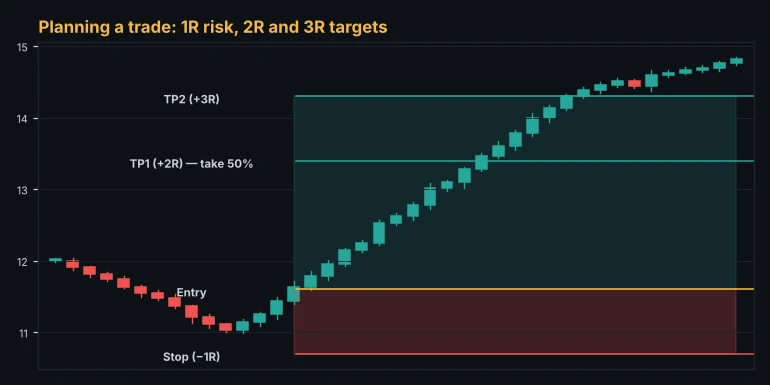
Leverage lets you open a position larger than the money in your account. Your broker or exchange holds part of your balance as a deposit, called margin, and lends you the rest.
Margin = Position value ÷ Leverage
With 1:100 leverage, a $100,000 EUR/USD position needs $1,000 of margin. With 1:10, it needs $10,000.
Margin needed for a forex, gold or crypto position. Free, no sign-up.
Open the margin calculatorThe most important point: leverage does not set your risk
Your profit or loss depends on the position size and how far price moves, not on the leverage. A 0.5-lot EUR/USD trade gains or loses $5 per pip whether your account is set to 1:30 or 1:500. Leverage only decides how much margin is locked up.
The danger is that high leverage makes it easy to open a position far too big for your account. If you size every trade from your stop loss and a fixed risk percentage, leverage becomes a background setting.
Lots and units from your risk and stop loss. Free, no sign-up.
Open the position size calculatorMargin level, margin calls and stop-outs
Your broker constantly compares your equity (balance plus open profit or loss) with your used margin:
Margin level = Equity ÷ Used margin × 100%
- When the margin level falls to the margin call level, often 100%, you cannot open new trades.
- If it keeps falling to the stop-out level, often 50% or lower, the broker starts closing your positions, largest loss first.
Keeping your used margin small compared with your equity keeps you far from both.
Liquidation in crypto futures
On crypto exchanges each futures position has its own liquidation price. On isolated margin, if price reaches it, the exchange closes the position and you lose the margin you put up for it.
At 10x leverage a move of roughly 10% against you is enough to liquidate a position; at 50x, about 2%. Bitcoin can move that much in an hour. The higher the leverage, the less room your trade has to breathe.
Where a leveraged futures position is liquidated. Free, no sign-up.
Open the liquidation price calculatorLeverage limits for retail traders
Many regulators limit leverage for retail clients. In the European Union, the limits set by ESMA are:
| Market | Maximum leverage |
|---|---|
| Major forex pairs | 30:1 |
| Other forex pairs, gold, major indices | 20:1 |
| Other commodities, minor indices | 10:1 |
| Individual stocks | 5:1 |
| Cryptocurrencies | 2:1 |
The UK and Australia have similar rules. Offshore brokers and crypto exchanges often offer much higher leverage, sometimes 100x or more. Higher available leverage does not mean you should use it.
How to use leverage safely
- Size from the stop. Decide your risk per trade first, then calculate the position size.
- Keep used margin low. Many experienced traders keep total used margin well below half their equity.
- Know your liquidation price on every crypto futures trade, and make sure your stop is far from it.
- Use isolated margin for single trades in crypto, so one position cannot drain your whole account.
- Account for funding and swaps. Holding leveraged positions overnight or for days has a cost.
Frequently asked questions
What leverage should a beginner use?
Leverage matters less than position size. If you size from your stop with 1% risk, a moderate leverage setting simply means less margin is locked up. On crypto futures, beginners are usually safest at 2x to 5x.
Can I lose more than my deposit?
With regulated forex and CFD brokers in many regions, retail clients have negative balance protection. On some brokers and products you can lose more than you deposited. On crypto exchanges using isolated margin, your loss on a position is limited to its margin.
Is 1:500 leverage dangerous?
The setting itself is not, but it makes it very easy to open a position far too large for your account. That is where the danger comes from.
This guide is for education only and is not financial advice. Trading involves a high risk of loss. Test any method on a demo account first and never risk money you cannot afford to lose.
Keep learning
 Trading basics
Candlestick Patterns Every Trader Should Know (and When They Fail)
How to read candlestick charts and the patterns that matter most: engulfing, pin bar, doji, inside bar, morning and evening star. Plus how to filter out false signals.
 Trading basics
Crypto vs Forex Trading: Which Market Is Better for You?
An honest comparison of crypto and forex trading. Trading hours, volatility, leverage, costs, regulation and what each market rewards, so you can choose the right one for your style.
 Trading basics
How to Calculate Position Size in Forex and Crypto (With Examples)
Learn the position sizing formula that professional traders use. Step-by-step examples for forex, gold and Bitcoin, plus the mistakes that blow up accounts.