
In this guide
Good trading days rarely happen by accident. Professional traders follow a routine: they prepare before the market moves, trade only during the hours that suit their strategy, and review their work at the end of the day. A routine removes guesswork and keeps emotions in check.
1. Pre-market preparation (15 to 30 minutes)
Check the economic calendar
Look for high-impact events in your markets: central bank decisions, CPI inflation, non-farm payrolls, GDP. Note the times. Many traders avoid opening new positions in the 15 to 30 minutes before a major release.
Read the higher-timeframe picture
For each market on your watchlist, check the daily and 4-hour charts. Is it trending up, down, or ranging? Write a one-line bias for each.
Mark the key levels
Draw the previous day's high and low, the nearest support and resistance zones, and any round numbers. These are where reactions are most likely.
Write the plan
For each market: "If price does X at level Y, I will look for Z." Include your maximum risk per trade and your daily loss limit.
2. Trade the active session
Every market has hours when it moves and hours when it drifts.
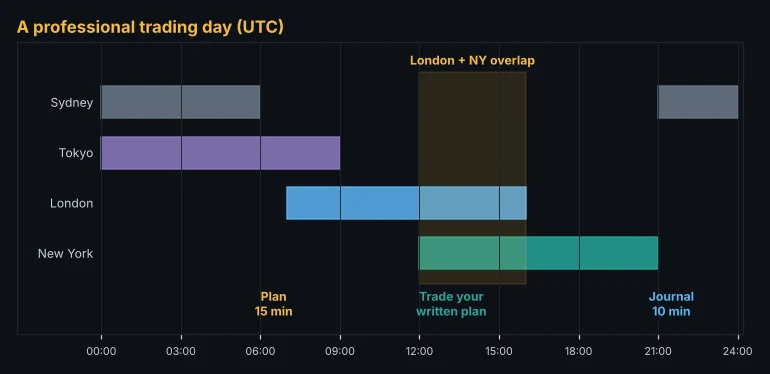
- Forex: the London session and the London–New York overlap (about 12:00 to 16:00 UTC) usually bring the most volume.
- Gold: the London open and the US session, especially around US data.
- Crypto: volume rises when Europe and the US are both active, roughly 13:00 to 20:00 UTC.
Live sessions and overlaps in your time zone. Free, no sign-up.
Open the forex market hoursDuring the session, wait for your setups at your levels. Use alerts so you do not need to stare at every candle. When a setup appears, size the position from the stop distance before you enter.
Lots and units from your risk and stop loss. Free, no sign-up.
Open the position size calculator3. Manage open trades
- Move the stop to break-even only at a planned point, such as after the first target.
- Do not add to losing positions.
- Respect your daily loss limit. If you hit it, close the platform.
4. End-of-day review (10 minutes)
Log every trade in your journal: the setup, entry, stop, target, result in R, and how you felt. Then ask three questions:
- Did I follow my plan?
- What did the market do that I did not expect?
- What will I do differently tomorrow?
5. Weekly review
Once a week, look at your statistics. Which setups make money? Which sessions? Which emotions lead to losses? Adjust your plan based on data, not on one bad day.
A sample routine
| Time (UTC) | Task |
|---|---|
| 06:30 | Calendar, higher-timeframe bias, key levels |
| 07:00 | Write the plan, set alerts |
| 07:00 to 10:00 | London session: trade planned setups |
| 12:00 to 16:00 | London–New York overlap: main trading window |
| 16:30 | Close the platform, journal the day |
Build your routine around Alice
Alice gives you each step in one place: the economic calendar with impact analysis, the daily market brief, support and resistance zones on every chart, alerts that the server checks around the clock, the market-hours tool in your time zone and a trading journal with statistics.
The Alice scanner scores every crypto, forex, gold and index market from 0 to 100 on every timeframe, so you can spot these setups in seconds.
Open the free web appFrequently asked questions
How many hours a day should I trade?
Quality matters more than hours. Many successful traders actively trade only two to four hours a day, during the most active session for their market.
What if I have a full-time job?
Trade a higher timeframe such as the 4-hour or daily chart, prepare in the evening, and use alerts and limit orders so you do not need to watch the screen.
Should I trade every day?
No. If there are no good setups or major news makes the market unpredictable, not trading is a valid decision.
This guide is for education only and is not financial advice. Trading involves a high risk of loss. Test any method on a demo account first and never risk money you cannot afford to lose.
Keep learning
 Trading basics
Candlestick Patterns Every Trader Should Know (and When They Fail)
How to read candlestick charts and the patterns that matter most: engulfing, pin bar, doji, inside bar, morning and evening star. Plus how to filter out false signals.
 Trading basics
Crypto vs Forex Trading: Which Market Is Better for You?
An honest comparison of crypto and forex trading. Trading hours, volatility, leverage, costs, regulation and what each market rewards, so you can choose the right one for your style.
 Trading basics
How to Calculate Position Size in Forex and Crypto (With Examples)
Learn the position sizing formula that professional traders use. Step-by-step examples for forex, gold and Bitcoin, plus the mistakes that blow up accounts.